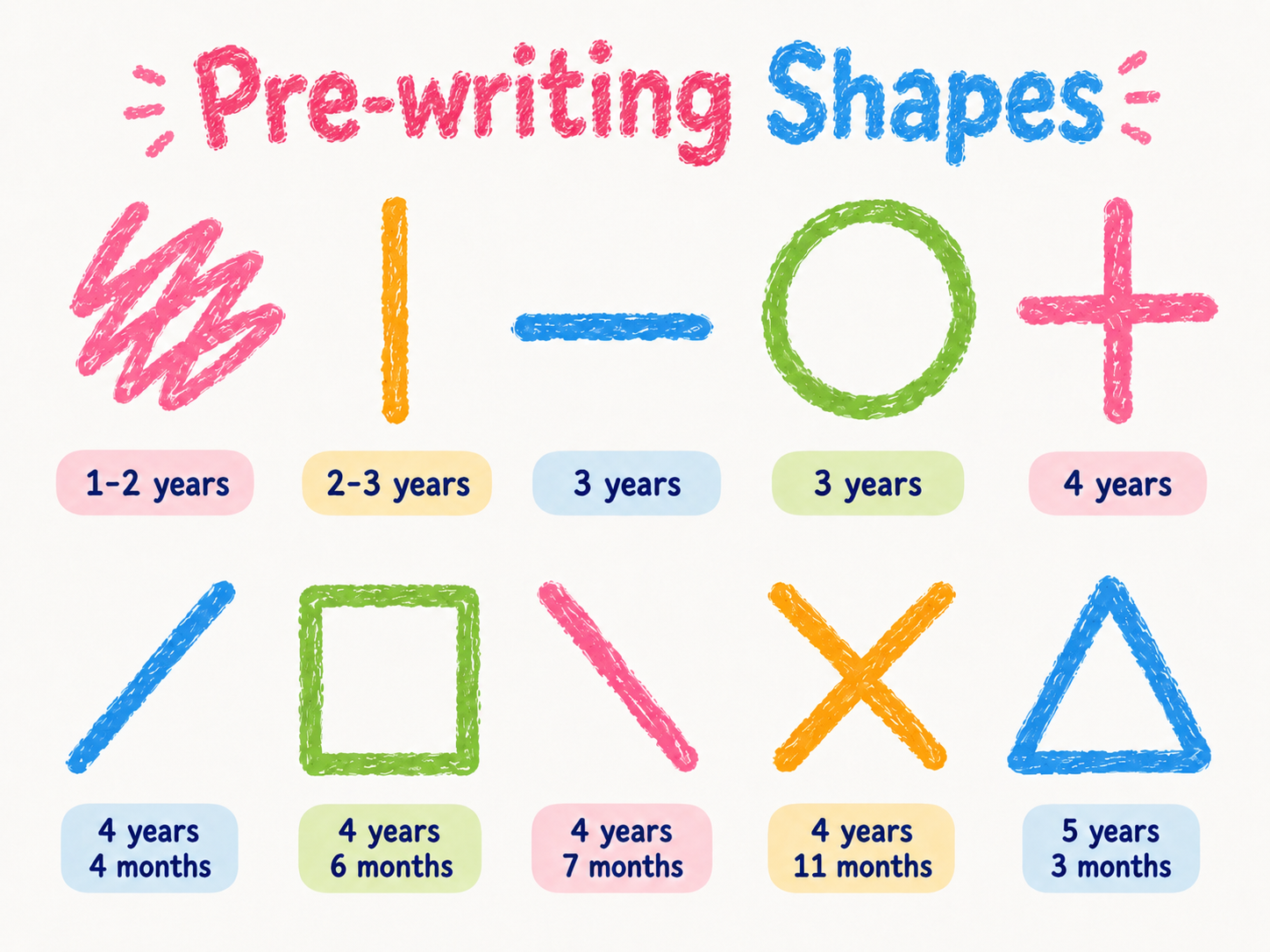
As parents, it's exciting when your child begins showing interest in writing. It's tempting to print out alphabet tracing worksheets and start practicing letters right away. But before children are developmentally ready to form letters, there's an important step that often gets overlooked: pre-writing shapes.
These simple lines and shapes are the building blocks of handwriting. Just as children learn to crawl before they walk, they benefit from mastering basic strokes before writing the alphabet.
What Are Pre-Writing Shapes?
Pre-writing shapes are the basic lines and forms that make up every letter we write. They typically develop in a predictable sequence:
- Scribbles
- Vertical lines
- Horizontal lines
- Circles
- Crosses (+)
- Squares
- Diagonal lines
- X's
- Triangles
As children practice these shapes, they develop the motor skills needed to eventually write letters with greater accuracy and control.
Why Are Pre-Writing Shapes So Important?
From a pediatric occupational therapy perspective, drawing these shapes is about much more than making marks on paper.
They Develop Fine Motor Skills
Drawing different lines and shapes strengthens the small muscles of the hands and fingers while improving pencil control, endurance, and hand stability.
They Build Visual-Motor Integration
Children learn to coordinate what their eyes see with how their hands move. This visual-motor integration is essential for copying shapes, writing letters, and staying on the lines.
They Improve Motor Planning
Each new shape requires children to think about where to start, which direction to move, and how to stop. This process strengthens motor planning, making letter formation easier later on.
They Prepare Children for Letter Formation
Almost every letter is made from combinations of these basic shapes.
For example:
- l, t, H begin with vertical lines.
- E, F use horizontal lines.
- O, C, G rely on circles.
- A, K, M, N require diagonal lines.
- X is simply two intersecting diagonals.
When children are comfortable making these shapes, learning letters becomes much less overwhelming.
Don't Forget the Power of Imaginative Drawing
One of the best ways to practice pre-writing shapes isn't through worksheets—it's through play.
When children transform circles into suns, squares into houses, triangles into mountains, or scribbles into silly monsters, they're doing far more than creating artwork.
They're also developing:
- Creativity
- Motor planning
- Problem-solving
- Confidence
- Pencil control
- Endurance
- Meaningful practice
Because the drawing has purpose and meaning, children are often more engaged and motivated than they would be during repetitive tracing activities.
Keep It Fun, Not Perfect
Remember, the goal isn't perfectly straight lines or flawless shapes.
The goal is exploration, practice, and confidence.
Offer plenty of opportunities to draw with crayons, markers, chalk, paint, or even sticks in the dirt. Celebrate effort over perfection and encourage your child to tell stories about what they've created.
Handwriting is a journey, and every scribble is an important step along the way.
The Bottom Line
Pre-writing shapes lay the foundation for successful handwriting by developing fine motor skills, visual-motor integration, motor planning, and pencil control.
Before asking children to trace or write letters, give them plenty of time to explore lines, shapes, and imaginative drawing.
After all, letters are simply combinations of shapes—and confident writers begin with confident scribblers. 💙✏️
Screenshot this free visual for your friends, students or children below: